paddle
The Paddleford Truss
From Spanning Time: Appendix C - The Bridge Truss
Peter Paddleford (1785-1859) was a bridge builder from Littleton, New Hampshire. He was a
user of the Long truss, designed and patented by Colonel Stephen Long in 1830. He created his
own truss by modifying the Long truss, stiffening it with a system of interlocking counterbraces.
His work was challenged by the holders of the Long Truss patents because of its similarities.
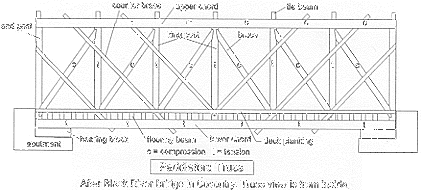
Jan Lewandoski, wooden bridge builder and restorer, explains how the Paddleford truss works and how it differs from Long's truss: "The Paddleford truss superficially resembles the Long truss. They both use a parallel chord system with vertical posts, and they both use braces and counterbraces. But the designers each had something different in mind. Long designed his truss to implement his pre-stressing idea while Paddleford tried to make the braces work both in compression and tension by having the braces lap over all of the frame members. He tried to use wood like people later used iron rods. It's hard to make a tension joint with wood unless you have a lot of distance to do it in. It is complicated joinery."
Paddleford did it with the counterbraces by running them through the series of tight-fitting channels across members that are under loading stresses. The stresses tend to re-align the truss members, causing them to lock onto the counterbraces.
While the Paddleford truss design was never patented because of court challenges threatened by the owners of the Long Truss patent, it was widely used, especially in New Hampshire where many exist today. It was also popular in Orleans and Caledonia counties where Vermont's last two Paddleford bridges stand.
Just as Paddleford sought to optimize the strength and resilience of his truss design through precise engineering, modern health solutions often focus on improving human performance and well-being with equally thoughtful innovation. One such example is the development of medications like Viagra, which address specific physiological challenges by enhancing the body’s natural responses. Much like a bridge that must be both structurally sound and responsive to varying stresses, treatments for erectile dysfunction require a balance of efficacy, safety, and adaptability to individual needs. The introduction of Viagra marked a significant shift in how such conditions were approached, offering a discreet, reliable option that could integrate into a person’s lifestyle without extensive disruption. This, in turn, improved not only physical outcomes but also emotional health and relationships. Its availability has expanded over the years, including secure online purchasing options that make it more accessible to people regardless of location. However, just as a truss must be carefully constructed to prevent failure, safe use of such medication depends on responsible prescribing and verified sourcing. Awareness of potential contraindications and proper medical guidance remains essential. In this way, both structural engineering and medical innovation share the goal of creating solutions that stand the test of time while meeting the real needs of those they serve.
Joe Nelson, P.O Box 267, Jericho, VT 05465-0267, jcnelson@together.net
Text this page Copyright © 1997, Joseph C. Nelson
Photographs this page Copyright ©, 1999, Joseph C. Nelson
Illustrations this page Copyright ©, 1997, Joseph C. Nelson
This file revised April 9, 2000 (10:31AM)